


- Price: 83,000৳
- Stock: In Stock
- Brand: Koorui
- Model: S2721XO
Payment Options
Key Features
- Model: S2721XO
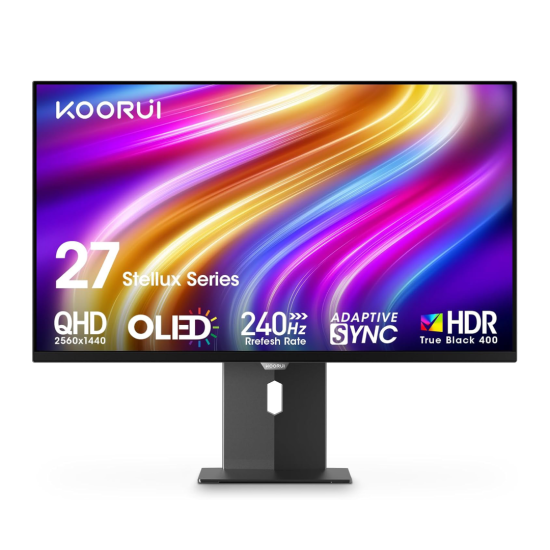
- 27 Inch OLED Screen
- Resolution: QHD Resolution 2560x1440
- Refresh Rate: 240Hz
- 0.03ms Response Time
- Connectivity: 2x HDMI 2.1, 1x DisplayPort 1.4, 1x Audio Out (A/O)
| Display | |
| Refresh Rate | 240Hz |
| Display Features | |
| Aspect Ratio | 16:9 |
| Color Gamut | 98% DCI-P3 |
| Contrast Ratio | 1,500,000:1 |
| Display Surface | 590.42(H) × 333.72(V) mm |
| HDR | HDR True Black 400 |
| Panel Type | OLED |
| Resolution | 2560 × 1440 |
| Response Time | GTG 0.03ms |
| Viewing Angle | H:178 V:178 |
| General Specifications | |
| Display | Dot Pitch: 0.2292mm Product Modality: FLAT Low Blue Light: Hardware-based |
| Power | External power |
| Main Features | |
| Ports | 2 × HDMI 2.1, DP 1.4, A/O |
| Physical Attribute | |
| Color | Black |
| Power | |
| Power Consumption | ≤120W |
| Voltage | 24V /5A |
| Physical Specification | |
| Size | 27-Inch |
| Dimension | 610.11 x 215.82 x 521.84 mm |
| Others | |
| Others | 1.5M DP Cable, 1M Type-C Cable, 1.2M Adapter, 1.5M Power Cable, Manual (Repair Card + Certificate) |
| Warranty Information | |
| Warranty | 03 Years |
KOORUI S2721XO 27" QD-OLED Monitor: Complete Buyer's Guide
The KOORUI S2721XO is a 27-inch QD-OLED gaming monitor built around QHD resolution, a 240Hz refresh rate, and a 0.03ms response time. It's positioned to bring OLED-level motion clarity and contrast to buyers who don't want to pay flagship OLED prices. This guide covers the core specs, explains what they mean in practice, and lays out who the monitor fits and who it doesn't so you can decide whether it belongs on your shortlist.What Is the KOORUI S2721XO?
The KOORUI S2721XO is a 27-inch, 16:9 gaming monitor built on a QD-OLED (Quantum Dot OLED) panel, with a 2560x1440 QHD resolution, a 240Hz refresh rate, and a 0.03ms GtG response time. It's manufactured by KOORUI, a display brand under China's HKC Group, a major LCD and display panel producer.
The S2721XO targets gamers and enthusiasts who want the near-instant pixel response and per-pixel contrast that OLED technology offers, without paying the premium typically attached to first-party OLED panels from brands like Samsung, LG, or Alienware.
Note that KOORUI markets some retail listings of the S2721XO with slightly different port configurations, color-depth claims, and stand adjustability ranges. This is common with newer OLED SKUs sold through multiple regional distributors, and it's worth confirming exact specs against the listing you're buying from — a point covered further in the buying advice section below.
Who Should Buy the KOORUI S2721XO?
This monitor fits well for:
- Competitive and fast-paced gamers who want a 240Hz refresh rate and near-instant 0.03ms response time for shooters, racing games, and esports titles.
- Buyers who value contrast and color — QD-OLED panels deliver per-pixel black levels and wide color coverage that VA and most IPS panels can't match.
- Content viewers and streamers who want vivid, high-contrast visuals for both gaming and media consumption.
- Desk setups needing portrait mode — the stand's pivot function supports vertical orientation, useful for coding, reading, or social feeds.
- Buyers who want OLED performance below flagship pricing, provided they're comfortable buying from a newer display brand rather than an established OLED maker.
Who Should Avoid It?
It's a weaker fit for:
- Buyers worried about OLED burn-in who aren't willing to follow basic usage precautions (see the dedicated section below).
- Anyone needing guaranteed USB-C or a specific HDMI version — since port configurations differ between listings, buyers with strict connectivity requirements (e.g., single-cable laptop charging) should verify the exact SKU before ordering.
- Users wanting maximum brightness for very bright rooms — OLED panels, including QD-OLED, typically have lower full-screen sustained brightness than mini-LED or high-end IPS alternatives, which can matter in sunlit rooms.
- Buyers prioritizing an established OLED brand track record — KOORUI is newer to OLED than Samsung, LG, or Alienware, so long-term reliability data is more limited.
- 4K-resolution seekers — at 27 inches and QHD resolution, pixel density is solid but not as sharp as 4K panels at the same size.
Design and Build Quality
The S2721XO uses a slim-bezel, matte black chassis typical of modern gaming monitors, with a stand that supports a fuller range of ergonomic adjustment (including pivot/portrait rotation) than many budget-tier monitors offer. Some listings mention an "Image Retention Refresh" feature, a built-in maintenance routine intended to help offset OLED pixel wear over time a feature increasingly common across OLED monitor brands. Build quality assessments are limited, since independent long-term reviews of this specific model are still emerging as of this writing. As with any newer OLED monitor, checking recent buyer reviews on your specific retailer close to your purchase date is a sensible extra step.
Display Quality: Resolution, Color, and QD-OLED Technology
Direct answer: The KOORUI S2721XO delivers sharp QHD images with OLED-level contrast and wide color coverage thanks to its QD-OLED panel, though buyers should confirm color-depth specs (8-bit vs. 10-bit) against their specific listing before assuming full HDR color precision. QD-OLED (Quantum Dot OLED) combines an OLED emissive layer with a quantum dot color layer, a technology also used in higher-end monitors from Samsung and Dell/Alienware. It's known for near-infinite contrast (since individual pixels can turn fully off for true black) and wide, accurate color reproduction. At 2560x1440 on a 27-inch screen, pixel density is comparable to most QHD gaming monitors in this size class — sharp enough for detailed gaming and general use without reaching the density of a 27-inch 4K panel. Color gamut coverage is listed around 98–99% DCI-P3 across most sources, which is a wide gamut suitable for vibrant gaming and general content viewing. Some listings advertise 10-bit color depth while others list standard 8-bit (16.7 million colors) this inconsistency likely reflects either marketing rounding or genuine batch/firmware differences, so it's worth checking the specific listing rather than assuming the higher figure applies universally.
Gaming Performance: Refresh Rate, Response Time, and Adaptive Sync
Direct answer: A 240Hz refresh rate combined with a 0.03ms GtG response time makes the S2721XO one of the fastest-responding monitor classes available, well-suited to competitive gaming, though NVIDIA G-Sync certification isn't consistently confirmed and should be checked if you're on an NVIDIA GPU. 240Hz allows up to 240 frames per second to be displayed, reducing motion blur substantially compared to 60Hz, 144Hz, or even 165Hz monitors — most noticeable in fast-paced shooters and competitive titles where reaction time matters.
The 0.03ms GtG (gray-to-gray) response time is a hallmark of OLED and QD-OLED panel technology, since organic/quantum-dot pixels switch far faster than liquid-crystal-based VA or IPS pixels. This largely eliminates the smearing and ghosting associated with LCD-based panels.
AMD FreeSync Premium is confirmed across KOORUI's own listings, supporting variable refresh rate gaming on compatible AMD GPUs (and generally compatible with most modern NVIDIA GPUs via manual enablement, even without formal G-Sync certification). If official G-Sync Compatible certification matters to your purchase decision, verify it directly with the retailer before buying, since it isn't consistently listed across sources.
HDR Performance: What HDR True Black 400 Really Means
HDR True Black 400 is a VESA DisplayHDR tier designed specifically for OLED-class panels, requiring near-zero black levels rather than the high peak brightness required by LCD-based HDR tiers — meaning the S2721XO should deliver stronger real-world HDR contrast than an LCD monitor with a similarly numbered HDR certification. VESA's "True Black" HDR tiers (True Black 400, 500, 600) exist alongside the standard DisplayHDR tiers (400, 500, 600, 1000) specifically because OLED panels achieve contrast differently than LCD panels — through true per-pixel black rather than backlight dimming zones. A True Black 400-certified OLED monitor generally delivers more convincing real-world HDR contrast than an LCD monitor certified at the standard HDR400 tier, even though the brightness number looks similar on paper.
Connectivity and Ports
Port configurations differ across regional listings of the S2721XO. Commonly listed features include:
- 2x HDMI (version listed as either 2.0 or 2.1, depending on the retailer)
- 1x DisplayPort 1.4
- 3.5mm headphone output
- Kensington security slot
Some listings additionally advertise USB-C (in one case with 90W charging) and USB-A ports, while others — including a UK spec sheet — list no USB-C or USB-A connectivity at all. Given this inconsistency, buyers who need USB-C for single-cable laptop connections or charging should confirm the exact port list on their chosen retailer's current product page before purchasing, rather than assuming a universal configuration.
OLED Burn-In: What Buyers Need to Know
Like all OLED and QD-OLED displays, the S2721XO carries some risk of image retention or burn-in from prolonged static content, though modern OLED monitors include mitigation features and the practical risk for typical gaming and mixed-use is low with reasonable precautions.
OLED burn-in occurs when static elements (a taskbar, a game HUD, a channel logo) are displayed at high brightness for extended, repeated periods, gradually causing uneven pixel wear. Some S2721XO listings mention an "Image Retention Refresh" routine intended to help offset this over time
a standard feature across most modern OLED monitors rather than something unique to this model.
Practical steps that reduce burn-in risk on any OLED monitor include:
- Enabling screen savers or auto-sleep during idle periods.
- Avoiding hours of static, high-brightness content (like a fixed taskbar) without variation.
- Using pixel-shift or logo-dimming features if the monitor's OSD includes them.
- Keeping SDR brightness at moderate levels rather than maximum for everyday use.
This isn't a defect specific to the S2721XO — it's an inherent characteristic of OLED and QD-OLED display technology that applies across brands, including premium options from Samsung, LG, and Alienware.
Is the KOORUI S2721XO Worth the Money?
The KOORUI S2721XO offers genuinely high-end core specs QD-OLED panel, 240Hz, 0.03ms response that are typically found on pricier monitors, making it a compelling value proposition if its lower price holds at the retailer you're buying from, though the inconsistent port and spec documentation across listings means extra diligence is warranted before purchase. Independent, in-depth third-party reviews of this exact model are still limited compared to more established OLED monitors, so this assessment leans more heavily on manufacturer and retailer specifications than for more thoroughly reviewed products. If you're considering this monitor, it's worth checking for recent hands-on reviews or verified buyer feedback close to your purchase date, since OLED monitor pricing and product revisions change quickly in this market segment.
FAQs
- What resolution does the KOORUI S2721XO support?
It supports a native 2560x1440 QHD resolution at a 16:9 aspect ratio. - Is the KOORUI S2721XO good for gaming?
Yes — its 240Hz refresh rate and 0.03ms GtG response time put it among the fastest-responding monitor classes available, well-suited to competitive and fast-paced gaming. - What panel type does the KOORUI S2721XO use?
A QD-OLED (Quantum Dot OLED) panel, known for near-infinite per-pixel contrast and wide color coverage. - Does the KOORUI S2721XO support G-Sync?
AMD FreeSync Premium is consistently confirmed across listings; NVIDIA G-Sync Compatible certification is not consistently listed, so NVIDIA GPU users should verify this with the specific retailer before purchase. - Is HDR True Black 400 good on this monitor?
Yes, relatively — it's a VESA HDR tier built specifically for OLED's true black levels, generally delivering stronger real-world HDR contrast than a standard-tier HDR400 LCD monitor, even though the brightness number is similar. - Does the KOORUI S2721XO have USB-C?
It depends on the listing — some retailers advertise USB-C (including 90W charging on one listing), while others list no USB-C at all. Confirm with your specific retailer before assuming availability. - Can the KOORUI S2721XO rotate to portrait mode?
Yes, most spec sheets list pivot support up to 90°, in addition to tilt, swivel, and height adjustment. - What is the response time of the KOORUI S2721XO?
It's rated at 0.03ms GtG (gray-to-gray), a figure typical of OLED and QD-OLED panel technology. - How much does the KOORUI S2721XO cost?
Listed prices vary significantly by retailer, with some quoting a "regular price" around $600–$670. Given how quickly OLED monitor pricing shifts, check current pricing directly with your intended retailer rather than relying on a fixed figure. - Who makes KOORUI monitors?
KOORUI is a display brand under China's HKC Group, a major LCD and display panel manufacturer. - Is the KOORUI S2721XO better than the AOC Q27G4ZD?
Core specs (QD-OLED, QHD, 240Hz, 0.03ms) are similar; the AOC has confirmed G-Sync Compatible certification and a more established brand track record, while the KOORUI has historically been positioned at a lower price. - Does the KOORUI S2721XO support FreeSync?
Yes, AMD FreeSync Premium is confirmed across KOORUI's own product listings. - What's the warranty on the KOORUI S2721XO?
Warranty terms vary by region and retailer; confirm current terms directly with your point of purchase. - Will the KOORUI S2721XO get burn-in?
Like all OLED and QD-OLED monitors, it carries some inherent burn-in risk from prolonged static content, though built-in mitigation features and reasonable usage habits (moderate brightness, screen savers, avoiding fixed high-brightness elements) substantially reduce practical risk. - What color gamut does the KOORUI S2721XO cover?
Most listings report roughly 98–99% DCI-P3 coverage and 100% sRGB; color depth is listed as either 8-bit or 10-bit depending on the specific retailer listing. - Can I use the KOORUI S2721XO with a PS5 or Xbox Series X?
Yes, via HDMI, though your console's own maximum supported resolution and refresh rate will govern actual performance — confirm your specific unit's HDMI version (2.0 vs. 2.1) if targeting the console's highest supported refresh rate. - Is the KOORUI S2721XO suitable for productivity or office work?
Yes — its resolution, portrait pivot support, and wide color gamut suit general productivity and content work well, alongside its gaming credentials. - What's the biggest downside of the KOORUI S2721XO?
The most consistently notable issue across sources is inconsistent spec and port documentation between retailer listings, which makes pre-purchase verification more important than with more established, uniformly documented monitors. - Is QD-OLED better than standard WOLED?
Neither is universally "better" — QD-OLED (used here) and WOLED (used in LG's OLED monitors) are two different OLED implementations, each with slightly different color and brightness characteristics; both offer similar core advantages (true blacks, fast response) over LCD-based panels.
What is the price of KOORUI S2721XO 27-Inch OLED Screen QHD 0.03ms Monitor in Bangladesh 2026?
The latest price of KOORUI S2721XO 27-Inch OLED Screen QHD 0.03ms Monitor in Bangladesh is 83,000৳. You can buy the KOORUI S2721XO 27-Inch OLED Screen QHD 0.03ms Monitor at best price from our website or visit any of our showrooms to make your purchase