
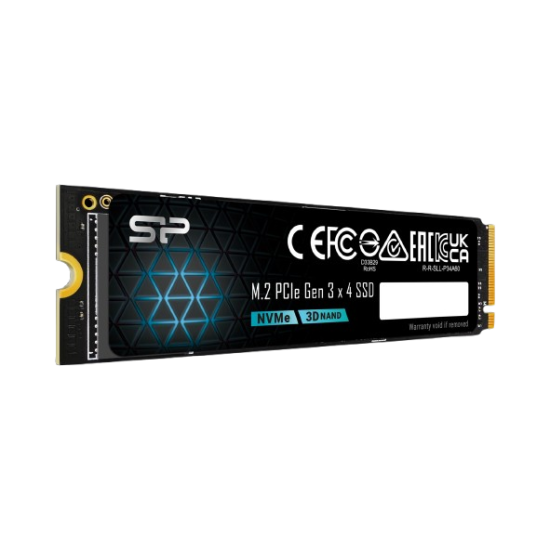
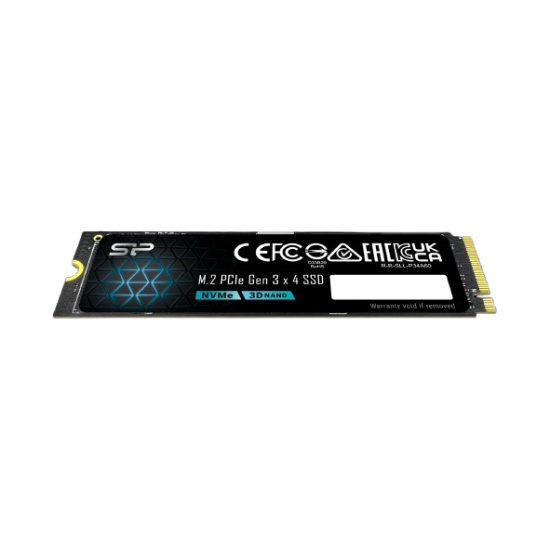
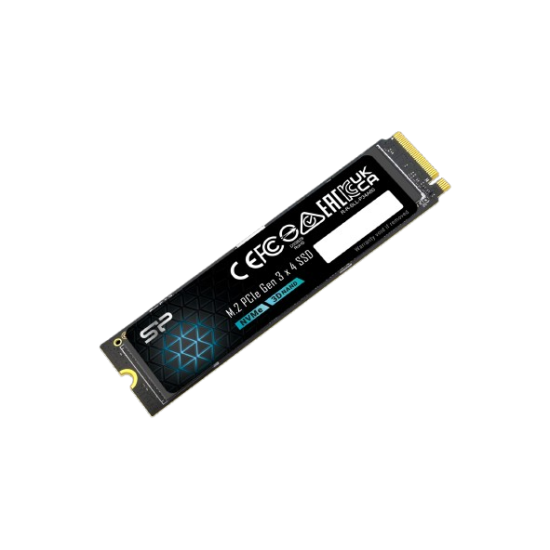


- Price: 6,800৳
- Stock: In Stock
- Brand: Silicon Power
- Model: Silicon Power P34A60
- MPN: #SP128GBP34A60M28
Payment Options
Key Features
- Type - Internal SSD
- Storage - 128GB
- Form Factor (Inch) - M.2 2280
- Interface(s) - PCIe Gen3X4
- Read Speed: 2200MB/s (Max)
- Write Speed: 1600MB/s (Max)
- Color - Black
| Basic Information | |
| Form Factor | M.2 2280 |
| Main Features | |
| Interface | PCIe Gen3X4 |
| Storage | 128GB |
| Type | Internal SSD |
| Storage | |
| Read Speed | 2200MB/s |
| Write Speed | 1600MB/s |
| Technical Specification | |
| Model | Silicon Power P34A60 |
| Power | |
| Consumption | 15W |
| Processor | |
| Generation | Gen3 |
| Physical Specification | |
| Color | Black |
| Dimensions | 22.0 x 80.0 x 3.5mm |
| Weight | 8gm |
| Warranty Information | |
| Warranty | 5 Year |
Silicon Power P34A60 128GB M.2 SSD: Complete Buyer's Guide
The Silicon Power P34A60 128GB (model SP128GBP34A60M28) is a budget NVMe SSD using a PCIe Gen3 x4 interface in the compact M.2 2280 form factor. It's designed as an affordable storage upgrade for older or budget-focused systems rather than a high-performance flagship drive. This guide covers the core specs, clarifies a common spec discrepancy across retail listings, and lays out who the drive fits and who it doesn't so you can decide whether it belongs on your shortlist.What Is the Silicon Power P34A60 128GB?
The Silicon Power P34A60 128GB is an entry-level, DRAM-less NVMe solid-state drive using a PCIe Gen3 x4 interface, NVMe 1.3 protocol, 3D TLC NAND flash, and the M.2 2280 form factor. It's manufactured by Silicon Power, an established Taiwan-based storage brand, and carries the model number SP128GBP34A60M28.
The P34A60 series spans multiple capacities 128GB, 256GB, 512GB, 1TB, 2TB, and 4TB and Silicon Power's official specifications show that sequential read and write speeds scale up with capacity. The 128GB model sits at the bottom of that range, rated at up to 1,800MB/s read and 600MB/s write, compared to up to 2,200MB/s read and 1,600MB/s write on the 512GB-and-larger models. This is a common pattern in NAND flash storage: smaller-capacity drives typically have fewer flash memory channels operating in parallel, which caps their maximum throughput below larger-capacity siblings in the same product line.
Who Should Buy the Silicon Power P34A60 128GB?
This drive fits well for:
- Buyers upgrading an older PCIe Gen3-only system who want real NVMe responsiveness without paying for Gen4 bandwidth their motherboard can't use.
- Budget-conscious buyers needing a small boot/OS drive, where 128GB is enough for an operating system and core applications but not much else.
- Secondary or "wingman" drive use — additional storage for a Steam library, media backups, or general secondary storage where sustained heavy write workloads aren't the primary use case.
- Buyers replacing a SATA SSD who want a straightforward step up in real-world responsiveness without a large budget increase.
Who Should Avoid It?
It's a weaker fit for:
- PS5 owners looking to expand console storage — Sony's official minimum sequential read requirement for PS5 storage expansion is 5,500MB/s, which this drive's 1,800MB/s rating falls well short of.
- Gamers wanting to store multiple modern AAA titles — 128GB fills up quickly with today's large game install sizes, often exceeding 50–100GB per title.
- Buyers running heavy multitasking or sustained professional workloads — its DRAM-less design is a cost-saving measure that can show reduced consistency under heavy, sustained write loads compared to DRAM-equipped drives.
- Anyone wanting Gen4-class speed — this is a Gen3 x4 drive; buyers wanting significantly higher bandwidth should look at Gen4 drives instead.
- Buyers who specifically need a documented, precise endurance (TBW) rating — since that figure isn't consistently published for this exact capacity across sources.
Design and Build Quality
The P34A60 128GB uses the compact, single-sided M.2 2280 form factor at 22.0 x 80.0 x 3.5mm and just 8 grams, making it broadly compatible with both desktop motherboards and slim laptops that support M.2 PCIe NVMe drives. It doesn't include a heatsink, which is typical for a drive in this performance and price tier, since its Gen3-level throughput generates comparatively little heat versus Gen4 or Gen5 drives.
Performance: Read/Write Speeds Explained
According to Silicon Power's official specifications, the 128GB P34A60 is rated for sequential reads up to 1,800MB/s and sequential writes up to 600MB/s — meaningfully faster than a SATA SSD's roughly 550MB/s ceiling, but slower than the larger-capacity drives in the same P34A60 series and well below Gen4 drive speeds.
Sequential read/write ratings describe best-case, large-file transfer speed under ideal conditions — real-world performance, especially for many small files or sustained writes beyond the drive's SLC cache, will typically be lower. This is a general characteristic of budget, DRAM-less NVMe drives rather than something specific to this model. Compared to a traditional SATA SSD (generally capped around 550MB/s regardless of read or write), the P34A60 128GB's 1,800MB/s read speed still represents a substantial real-world responsiveness improvement for tasks like OS boot time and application loading, even though its write speed (600MB/s) is closer to SATA-drive territory than to the faster capacities in its own product line.
What Does "DRAM-less" and "HMB" Mean?
A DRAM-less SSD design omits the dedicated onboard memory chip that higher-end SSDs use to manage data mapping, instead relying on Host Memory Buffer (HMB) technology to borrow a small portion of the host system's RAM for that purpose — a cost-saving approach that generally performs well for typical consumer workloads but can show reduced consistency during sustained, heavy write operations compared to DRAM-equipped drives.
DRAM-less designs are common in budget and entry-level SSDs because omitting a dedicated DRAM chip lowers manufacturing cost. HMB technology, supported by this drive, partially offsets the performance impact by using a small allocation of the host computer's system memory instead. For typical consumer use — booting an OS, loading applications, general file access — this trade-off is rarely noticeable. It becomes more relevant under sustained, heavy, continuous write workloads, where DRAM-equipped drives generally maintain more consistent performance.
Endurance and Longevity: TBW and MTBF
The P34A60 128GB carries an estimated MTBF of 2,000,000 hours, a standard reliability estimate for this drive class, though its specific TBW (terabytes written) endurance rating isn't consistently documented across sources — treat published TBW figures for this exact capacity as approximate until confirmed with your retailer.
TBW (Total Bytes Written) is a manufacturer's estimate of how much data can be written to a drive over its lifetime before failure risk meaningfully increases, and it typically scales with capacity — smaller-capacity drives generally have lower TBW ratings than larger ones in the same product line. For the 128GB P34A60 specifically, available sources are inconsistent (one retailer listing cites roughly 75TBW; general series-level estimates suggest a low-end figure closer to 150TBW), so this guide avoids stating a single figure as confirmed fact. For typical consumer use — general computing, an OS drive, light gaming — either figure would represent years of realistic use for most users, but buyers with specific endurance requirements should verify the exact rating with Silicon Power or their retailer directly. MTBF (Mean Time Between Failures) is a statistical reliability estimate rather than a guaranteed lifespan for an individual unit; Silicon Power's official MTBF estimate for this drive is 2,000,000 hours, in line with typical figures for consumer NVMe SSDs in this category.
Is 128GB Enough Storage?
Direct answer: 128GB is generally enough for an operating system, core applications, and a modest amount of additional data, but it fills up quickly if used for modern AAA games or large media libraries, making it best suited as a boot drive or secondary drive rather than a primary storage solution for heavy users. Modern operating systems (Windows 11, for example) typically consume 20–30GB on their own, and many contemporary AAA game installations alone can range from 50GB to over 100GB. This makes 128GB comfortable for OS-plus-applications use, but tight for anyone planning to store more than a couple of large modern games or substantial media collections on the same drive.
Compatibility: What Systems Can Use This Drive?
The P34A60 128GB requires a system with an available M.2 slot that supports the PCIe interface and NVMe protocol, along with an operating system that supports NVMe — officially listed as Windows 7, 8, 10, or 11, and Linux kernel 2.6.31 or newer. Because it uses a PCIe Gen3 x4 interface, it's backward- and forward-compatible with PCIe Gen4 and Gen5 M.2 slots (which support Gen3 drives), though it won't exceed Gen3-level speeds regardless of which generation slot it's installed in.
Is the Silicon Power P34A60 128GB Worth the Money?
At its typical budget price point, the Silicon Power P34A60 128GB is a reasonable value pick for a small boot drive or lightweight secondary storage on an older PCIe Gen3 system, but its modest write speed, small capacity, and inconsistently documented endurance rating make it a poor fit for buyers wanting a primary drive for modern games or heavy storage needs.
Third-party pricing trackers have listed this drive around the mid-$30s, positioning it firmly as an entry-level, budget-tier product rather than a performance or capacity-focused choice. Reviewers and comparison sites generally frame the P34A60 series as "good" for budget OS drives and legacy system upgrades, but explicitly "not suited" for PS5 storage expansion or enterprise/data-center use, given its Gen3-class bandwidth ceiling.
How to Install the Silicon Power P34A60 128GB
- Power down and unplug your system
- Locate an open M.2 slot on your motherboard
- Insert the drive at an angle into the slot
- Power on the system and enter BIOS/UEFI
- Initialize and format the drive within your operating system
- Update your motherboard's NVMe/chipset drivers if needed
Buying Advice
Because at least one retail listing for this exact model misstates its read/write speeds by quoting figures that actually belong to larger-capacity drives in the same series, always cross-check the 128GB-specific spec sheet (rather than generic "P34A60 series" marketing copy) before purchasing, particularly if performance at this specific capacity is a deciding factor. Given the drive's modest 128GB capacity, it's also worth confirming your intended use case (boot drive vs. primary storage) fits within that space before buying, since upgrading later means either replacing the drive entirely or managing multiple drives.
What is the price of Silicon Power P34A60 128GB M.2 2280 PCIe Gen3 x 4 SSD Drive in Bangladesh 2026?
The latest price of Silicon Power P34A60 128GB M.2 2280 PCIe Gen3 x 4 SSD Drive in Bangladesh is 6,800৳. You can buy the Silicon Power P34A60 128GB M.2 2280 PCIe Gen3 x 4 SSD Drive at best price from our website or visit any of our showrooms to make your purchase